

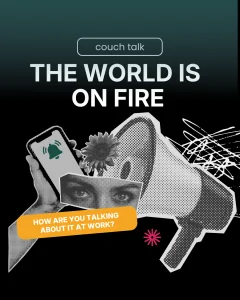
As a leader, your morning often starts the same way: you wake up, pick up your device, and are immediately met with heart-wrenching headlines and global tragedies. We are the first generation to experience global crises at such a personal, local frequency.
Then, minutes later, you’re expected to jump on a Zoom call, “put on a face,” and pitch a project or lead a team as if your nervous system isn’t currently vibrating with stress.
This is Digital Whiplash. In our latest episode of Couch Talk, we sat down with Ginny Santos, founder of Neolé and expert in creativity and leadership, to discuss how founders and managers can stay grounded when the world feels like it’s burning.
Watch the Full Conversation: The World Feels on Fire.
1
Your Nervous System is "Linking" (Even on Zoom)
One of the most fascinating takeaways from our talk with Ginny is that humans are constantly reacting to their environment. If your environment is a digital device triggering sadness, worry, or empathy, your nervous system is “on fire” before your first meeting begins.
Even if you don’t verbally mention the news, your body communicates your state through your pupils, your skin, and your energy.
The Invisible Connection: On a call, your nervous system and the other person’s nervous system are “linking”.
The Trust Gap: If your words say “I’m fine” but your nervous system is communicating high stress, it creates a lack of trust.
2
The "Deer" Metaphor: Learning to Shake It Off
Ginny shared a powerful analogy about a pack of deer. When a predator attacks, the deer run for their lives in a state of high “sympathetic mode” (fight or flight). However, 30 seconds after the danger passes, they go right back to grazing, fully relaxed.
Humans have lost this natural ability because our evolved brains get “locked” into stories about the past or worries about the future.
Try this: To regulate your nervous system, don’t just try to “think” your way out of it. Use somatic exercises like taking deep breaths, going for a brisk walk, or literally “shaking” your body for 60 seconds to signal to your brain that the danger has passed.
3
Curiosity is More Powerful Than Information
Many leaders feel an immense pressure to be “fully informed” so they aren’t caught off guard or seen as “ignorant” in difficult conversations. But being “hyper-informed” often leads to black-and-white thinking and divisiveness.
The Shift: Instead of entering a conversation with a stack of facts to “win,” enter with curiosity.
The Language: Normalize saying, “I don’t know enough about that yet, but I’m curious to hear your perspective”. This creates human connection rather than division.
4
Creating a Safe Space for Your Team
How do you check in with your team without opening a “Pandora’s Box” of vulnerability that you can’t manage? Ginny suggests creating rituals and traditions that give designated space for the human element.
The “End-of-Week Checkout” Framework:
- Pride: What is one thing you accomplished this week (big or small)?
- Self-Care: What is one thing you did for yourself this week (e.g., a walk, a green smoothie, or even a break from the news)?
- Support: What specific support do you need from the team next week?
Leading in a world that feels like it is “on fire” doesn’t mean you have to ignore the headlines or suppress your empathy. Instead, it requires a shift from being reactive to being regulated. By prioritizing your own nervous system and encouraging your team to do the same, you move from a state of “digital whiplash” to one of resilient, human connection. Remember that your most powerful tool isn’t having all the answers or the most information – it is the ability to stay present, stay curious, and create a space where your team feels safe enough to thrive.